


Most founders and growth teams are not losing money because Meta Ads “stopped working.” They are losing money because their creatives stopped earning attention. That is the real problem.
A weak Meta Ads creative strategy does not fail suddenly. It slowly bleeds performance. CTR starts dropping. CPA begins rising. ROAS becomes unstable. Frequency increases. The same ad that looked like a winner two weeks ago starts feeling dead.
Meta defines creative fatigue as a situation where the audience has seen the same image or video too many times, making them less likely to engage. But changing the background color won’t save your ROAS. To solve this, you need a practical system for building Meta ad creatives that earn attention fast, reduce fatigue, and support profitable scaling.
Not pretty ads. Performance creatives.
Why Scroll-Stop Matters More Than Viral Reach
Viral content is not always useful for paid acquisition. A viral post can get likes from the wrong audience. A scroll-stopping Meta ad earns attention from the right buyer at the right moment.
That difference matters:
- For a D2C brand, scroll-stop can mean better product discovery.
- For a SaaS company, it means a founder actually understands the pain before skipping.
- For an EdTech company, it means more qualified, high-intent leads.
Creative is not a small lever. Nielsen’s analysis of nearly 500 FMCG campaigns found that creative remained the most important sales driver. Circana’s updated studies also confirm that advertising creative drives nearly half of incremental sales, ahead of targeting and reach.
So when a campaign is not scaling, your first question should not be: “Should we change the audience?”
The better question is: “Has the creative earned enough attention, trust, and intent to deserve more budget?”
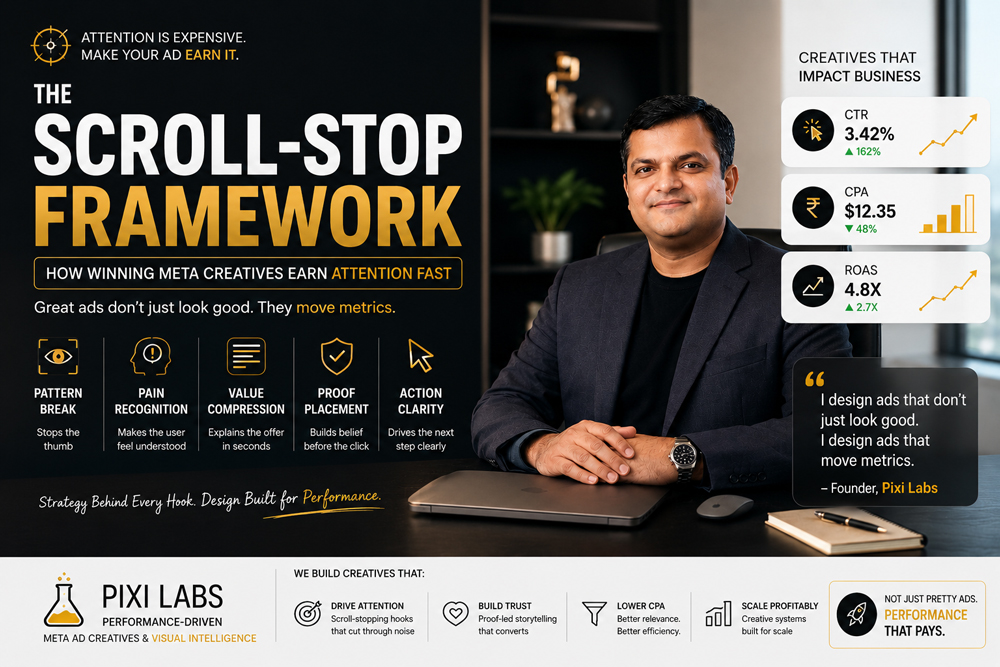
The Scroll-Stop Framework: 5 Layers of High-Converting Ads
Winning Meta creatives usually work because they solve five attention problems quickly. A creative must do all five. Not one. Not two. Attention alone does not pay the bills; it must move into belief, and belief must move into action.
| Layer | What It Solves | Business Impact |
|---|---|---|
| Pattern Break | Stops the thumb from scrolling | Higher hook rate and CTR |
| Pain Recognition | Makes the user feel understood | Better relevance and engagement |
| Value Compression | Explains the offer fast | Lower confusion, better click quality |
| Proof Placement | Builds belief before the click | Higher trust, stronger conversion intent |
| Action Clarity | Tells the user exactly what to do next | Better landing page transition, CPA control |
1. Pattern Break: Make the Brain Pause
The first job of a Meta ad is to interrupt autopilot. People scroll fast. They are not reading like a landing page; they are scanning for something that feels relevant, unusual, or emotionally sharp.
A strong pattern break (visual hook) can come from:
- A bold first-frame statement.
- A face with direct eye contact.
- A shocking before/after contrast.
- A visual mistake the buyer instantly recognizes.
Example for an e-commerce skincare brand:
- Weak hook: “Try our new natural skincare range.”
- Scroll-stop hook: “Your skin is not dry. Your barrier is damaged.”
The second one creates tension. It makes the buyer pause because it reframes the problem. That is performance creative thinking.
2. Pain Recognition: Make the Buyer Feel Diagnosed
Most bad ads describe the product too early. Winning ads diagnose the buyer first. People do not click because your design looks premium. They click because the ad makes them feel: “Exactly. This is my problem.”
- For D2C: “Your workout plan is not the issue. Your protein gap is.”
- For SaaS: “You do not need more data. You need faster decisions.”
- For EdTech: “Your creative is attracting curiosity, not commitment.”
This is where Pixi Labs separates itself from generic design agencies. A generic agency asks, “What colors do you want?” A performance creative partner asks, “What belief must change before this person clicks?”
3. Value Compression: Say More With Less
Meta recommends keeping ad copy short, communicating clearly what you want people to do. That does not mean your idea should be shallow; it means it must be compressed.
- Bad creative: “Premium AI analytics course with mentorship, case studies, lifetime access, and placement guidance.”
- Better creative: “Stop learning dashboards. Start solving business problems with data.”
For paid creative, compression beats explanation. Use this formula: Problem → Reframe → Outcome.
4. Proof Placement: Build Trust Before the Click
A scroll-stop ad without proof creates curiosity. Curiosity alone creates low-quality clicks. Premium buyers and founders need proof before they move.
Use proof elements like:
- Before/after creative comparisons
- CTR improvement snapshots
- Customer quotes or Founder-led diagnosis
- Product demo frames
Kantar and WARC evidence suggests creative quality plays a major role in profit impact. Do not just make the ad attractive. Make the buyer believe faster.
5. Action Clarity: Do Not Make the Buyer Guess
Many Facebook ad creatives lose money after getting attention because the next step is unclear.
- Weak CTA: “Learn More” | Better CTA: “Download the Creative Audit Checklist”
- Weak CTA: “Book a Call” | Better CTA: “Book a 20-minute Meta Creative Audit”
Action clarity improves conversion quality because it sets the expectation before the click, meaning fewer junk clicks and stronger CPA control.
Visual Psychology: What Actually Stops the Scroll
The best Meta creatives use visual psychology triggers to command the feed.
| Visual Trigger | Why It Works | Best Use Case |
|---|---|---|
| Face + Emotion | Humans scan faces fast | Founder ads, UGC, EdTech |
| Contrast | Creates instant visual priority | Before/after, problem framing |
| Large Readable Text | Helps fast comprehension | Reels, Stories, Feed ads |
| Product-in-Context | Shows real usage | D2C, e-commerce, beauty |
| Proof Overlays | Builds belief quickly | Case studies, B2B offers |
For Reels and Stories, format matters. Meta’s Reels guidance emphasizes vertical video, quality audio, and keeping key messages inside the safe zone. A beautiful ad where the CTA is hidden behind the Reels UI is not premium; it is expensive waste.
Creative Testing: Stop Testing Random Designs
Most brands say they are testing creatives, but they are actually testing random variations (one blue ad, one UGC ad, one product image). That is guessing with budget. A better Meta ad creative testing system separates variables.
- Test by Angle:
- Pain angle: “High CPA is not a media problem”
- Objection angle: “Your audience is not bored. Your message is repetitive.”
- Test by Format: Founder-led video, UGC-style video, Static image, Carousel.
- Test by Execution: Headline, first frame, color contrast, proof placement.
Metrics That Matter for Ad Fatigue Solutions
We track scale, not just “likes.” Here is how you should measure performance:
- Thumb-Stop Ratio (Hook Rate): Did the visual hook work? (Target: 25-30%+)
- Hold Rate: Did the value pitch keep them watching?
- Outbound CTR: Did the creative drive action? (Target: 1.5% – 2%+)
- CPA / ROAS: Is the ad actually profitable?
When these metrics drop, do not just refresh the color. Change the first-frame tension. Add stronger credibility. Track fatigue early before your CPA explodes.
Why Pixi Labs Is the Best Partner for Solving Ad Fatigue
Pixi Labs is not a generic design studio. We are specialists in Performance-Driven Meta Ad Creatives & Visual Intelligence.
Generic design agencies make ads look better. Pixi Labs makes ads work harder. We audit your ad account, map your customer journey, and design modular creatives built specifically for rigorous A/B testing and scaling.
Representative Case Study: D2C Brand Creative Fatigue Reset
- Client Context: A mid-size D2C wellness brand was running Meta Ads with stable spend but declining performance. CTR had dropped, CPA was rising, and winning creatives were burnt out.
- The Problem: The brand was refreshing design layouts, but not refreshing the buyer psychology. Every creative said the same thing. The audience had no new reason to stop.
- Pixi Labs Approach: We rebuilt the creative matrix around 5 distinct buyer pain angles. We created high-contrast, thumb-stop first frames for each. We designed native, UGC-style variations for trust and overlaid real product outcome proof.
- The Outcome: The new system improved CTR, significantly reduced CPA pressure, and extended the lifespan of their campaigns by feeding Meta’s algorithm highly differentiated assets.
- The Insight: “We did not need more designs. We needed a sharper reason for the buyer to care.”
That is what Pixi Labs solves. Not ad design as decoration. Creative as a revenue system.
FAQ: Meta Ads Creative Strategy
- What is a Meta Ads creative strategy?
A Meta Ads creative strategy is the system behind what your ads say, show, test, and optimize. It connects creative decisions (hooks, formats, proof placement) to business outcomes like CTR, CPA, and ROAS. It is about making the right audience stop, understand, believe, and act.
- How do I stop ad fatigue in Meta Ads?
Refresh the creative angle, not just the design. If the audience has seen the same promise too many times, changing colors won’t fix it. Build new hooks, introduce new proof points, and test new formats. Monitor early fatigue signals like CTR decline and frequency increase.
- What makes a Meta ad scroll-stopping?
Fast visual or emotional interruption. It requires a strong first frame, clear text, high contrast, a relatable pain point, and a specific reason to care. A buyer should understand the problem and the value within the first three seconds.
- How often should I test new Meta ad creatives?
It depends on your spend and audience size. High-spend campaigns need faster creative rotation. Maintain a continuous creative pipeline and launch tests as soon as you see early fatigue signals, rather than waiting for your CPA to become unprofitable.
- Are UGC ads better than designed ads?
UGC ads are not automatically better. They work when they feel native and build trust. However, for premium brands, SaaS, and high-ticket offers, well-designed ads often outperform when they clearly communicate positioning and proof. The key is format-market fit.
- What is creative diversification in Meta Ads?
Creative diversification means producing different assets for different personas, use cases, and formats. It prevents reliance on a single “perfect” ad and gives Meta’s AI-enabled tools a broader library of angles and visuals to match with the right users.
- How do I know if my creative is hurting my CPA?
Your creative is hurting your CPA if your Outbound CTR drops, your hook rate declines, or if you are getting cheap clicks that immediately bounce off your landing page. A proper audit checks the alignment between the ad’s hook, the proof, and the landing page continuity.
Conclusion: Winning Creatives Earn Attention, Trust, and Action
The era of cheap reach on Meta is over. The best Meta Ads creative strategy is not built around random inspiration or aesthetic preferences; it is built around rigorous diagnosis and visual psychology.
Your creative must break the pattern and stop the scroll. It must make the buyer feel understood. It must compress the value. It must prove the claim. And finally, it must give total clarity on the next action.
If your Meta Ads are spending but not scaling, do not start by blaming the algorithm. Audit the creative first.
About the Author