



You’re logging into your Ads Manager on a Tuesday morning. You look at the dashboard, and your CPA is creeping up again. Your immediate instinct as a founder or growth lead? Tweak the audience. Duplicate the ad set. Maybe blame the latest Meta algorithm update or an Advantage+ glitch.
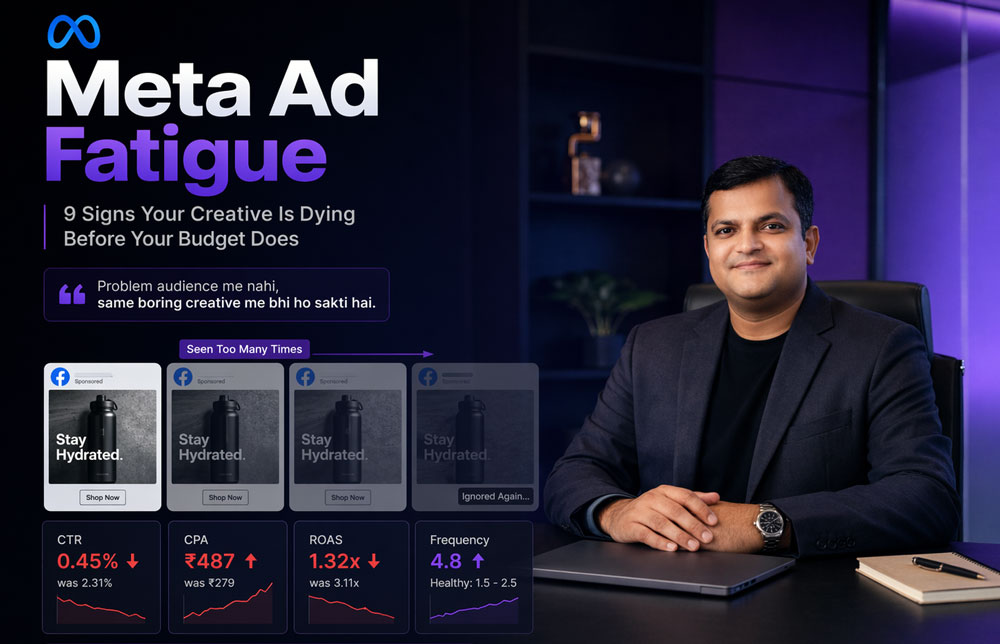
But let me give you the hard truth: Problem audience me nahi, same boring creative me bhi ho sakti hai. (The problem might not be the audience; it could just be your same boring creative.)
If you are a founder, CMO, or growth leader scaling a D2C, SaaS, or EdTech brand, Meta ad fatigue is the silent killer of your profitability. In the current era of Meta Ads-where Advantage+ Shopping Campaigns (ASC) and AI-driven broad targeting have automated media buying-creative is the only real lever you have left.
Quick Executive Summary: Meta ad fatigue occurs when your target audience stops responding to an ad due to visual overexposure, causing Meta’s algorithm to penalize your auction bids and charge you more for less real estate. The fastest, most profitable way to cure it isn’t changing your targeting-it’s injecting a rigorous, data-driven creative testing system to systematically rotate high-converting visual hooks.
Stop wasting thousands of dollars in ad spend on exhausted assets. In my 10+ years of designing direct-response creatives and auditing ad accounts, I’ve seen this pattern destroy profit margins. Here are the 9 undeniable signs your creative is dying, the psychology behind why it happens, and exactly what you need to do about it.
The New Reality of Meta Advertising
Before we dive into the symptoms, we need to address the root cause. A few years ago, you could hack your way to a high ROAS through hyper-specific interest targeting and lookalike audiences. Today, Meta’s machine learning is smarter than any human media buyer.
Targeting is now done by the creative itself.
If your creative speaks to a tired, overused pain point with a visual style they have seen a hundred times, they will scroll. And every time they scroll, your ad’s relevance score drops, your CPMs rise, and your budget bleeds. Recognizing ad fatigue early is the difference between a scalable month and a cash-flow crisis.
9 Undeniable Signs Your Meta Ad Creative is Fatigued
1. The Outbound CTR Death Drop
Click-Through Rate (CTR) is your absolute first line of defense. It measures the raw stopping power of your ad.
- The Metric: Your outbound CTR drops below 1% (or falls 20-30% below your account’s historical baseline) while impressions remain steady.
- The Psychology: Ad blindness. The human brain is wired to ignore repetitive stimuli. Your audience literally no longer registers your ad as new information in their feed.
- The Executive Fix: Do not change the core offer yet. Redesign the visual hook. Change the first 3 seconds of the video or test a highly contrasting background color for your static image to disrupt the visual pattern of the feed.
2. Your Thumb-Stop Ratio Dips Below 20%
As a growth leader, you need to track the Thumb-Stop Ratio (calculated as 3-second video plays divided by total impressions). This metric tells you if your video intro is actually working.
- The Metric: A Thumb-Stop Ratio falling below 20%.
- The Psychology: The prospect is mildly interested in your brand, but your hook isn’t aggressive or curious enough to make them pause their thumb. The creative isn’t fatigued at the end; it’s dying before it even begins.
- The Executive Fix: Implement a “Hook Testing Pipeline.” Take your winning video body and attach 5 completely different introductory clips to the front. Test a bold statement, an unusual sound, or native UGC (User Generated Content) style text.
3. CPA Creeps Up Unpredictably
This is the metric that directly hurts your bottom line and ruins your unit economics.
- The Metric: Cost Per Acquisition (CPA) starts at a profitable $15, but over three to four weeks, it slowly climbs to $35 for the exact same conversion volume.
- The Psychology: Meta is running out of “cheap” users in your target pool who resonate with that specific creative. It is now forcing the ad onto users who need more convincing, which costs you more money.
- The Executive Fix: If your landing page conversion rate is stable, the problem is entirely top-of-funnel. Pause the ad. It has done its job. Shift that budget into a new creative concept designed to appeal to a different psychological buyer persona (e.g., switch from “Features/Benefits” to “Social Proof/Trust”).
4. High Frequency Paired With Zero Action
Seeing an ad multiple times is only good if it eventually drives the user to take action. If it breeds annoyance, your creative is actively harming your brand equity.
- The Metric: Your frequency pushes past 3.5 or 4.0 over a 7-day window, but your daily conversions have flatlined.
- The Psychology: The user has already made the decision not to buy based on this specific argument. Showing it to them a fifth time won’t change their mind; it will just irritate them.
- The Executive Fix: Introduce format variation. If they have seen your video four times, hit them with a simple, text-heavy static graphic or a carousel highlighting customer reviews. Change the medium, not just the message.
5. Meta’s Algorithm Shifts Spend Away Automatically
Meta’s machine learning is incredibly ruthless when it comes to performance.
- The Metric: Inside a CBO (Campaign Budget Optimization) campaign, a formerly winning ad suddenly stops getting budget allocation.
- The Psychology: The algorithm has detected a drop in user engagement and predicted that serving this ad will result in a negative user experience. Meta protects its ecosystem first.
- The Executive Fix: Don’t fight the algorithm. If Meta turns off the tap, it knows the creative is dead before you do. Do not force spend onto it. Analyze why it died, extract the learning, and launch a new iteration.
6. The “Winning Angle” Suddenly Fails
You found a killer angle-maybe a sharp “Us vs. Them” comparison matrix or an ASMR unboxing video. It crushed your KPIs for a solid month. Now, it’s tanking.
- The Metric: A sharp, sudden drop in ROAS on a specific messaging angle across all ad variations using that angle.
- The Psychology: Angle fatigue. The audience has bought into the logic, and the early adopters have already converted. The remaining audience doesn’t care about the “Us vs. Them” argument.
- The Executive Fix: You don’t need a new product; you need a new psychological angle to capture the next tier of buyers. Pivot from logical arguments to emotional storytelling, or shift from a “Desire” angle to a “Fear of Missing Out (FOMO)” angle.
7. Engagement Turns Stale or Negative
Ads are a two-way conversation. Engagement is a massive trust signal for other potential buyers.
- The Metric: Comments drop to zero, or worse, you start getting angry or sarcastic comments complaining about seeing the ad too much.
- The Psychology: The social proof has evaporated. Without positive community reinforcement in the comments, skeptical buyers will bounce.
- The Executive Fix: Refresh the creative entirely. Sometimes, taking the exact same video, rendering it with slightly different text overlays, and launching it as a new Post ID will clear out the negative baggage and give you a fresh start in the auction.
8. Link Click-to-Landing Page View Drop-off
Sometimes, ad fatigue manifests as extremely low-quality clicks.
- The Metric: The gap between Link Clicks and Landing Page Views widens significantly (e.g., 100 clicks but only 30 landing page views).
- The Psychology: People are clicking accidentally, or they click out of mild, bored curiosity but don’t have the intent to wait for the page to load. Your ad is generating “cheap” clicks, not high-intent traffic.
- The Executive Fix: Ensure your ad creative perfectly matches your landing page headline. If the ad is clickbaity just to get attention, the drop-off will kill your tracking pixel’s data quality. Align the visual scent from ad to website.
9. ROAS Takes a Nosedive
This is the ultimate business metric. Aesthetics do not matter if the cash register isn’t ringing.
- The Metric: Your Return on Ad Spend (ROAS) drops from a scalable 3.5x to a barely-breaking-even 1.2x on a specific creative.
- The Psychology: The ad has fully exhausted its profitable lifespan.
- The Executive Fix: Cut it immediately. Don’t get emotionally attached to an ad that worked last quarter. Ad design is a revenue engine, not an art gallery. Move on to your next round of testing.
Fatigue vs. Bad Targeting: The Executive Diagnostic Matrix
When performance drops, use this table to quickly diagnose if you have an audience problem or a creative problem.
| Metric Indicator | True Ad Fatigue | Bad Audience Targeting |
|---|---|---|
| Initial Performance | Strong CTR and highly profitable CPA in weeks 1-2. | Poor CTR and high CPA from day one. |
| Frequency Metric | High (usually 3.0+ over a short window). | Low to medium (rarely passes 1.5). |
| Thumb-Stop Ratio | Started high (30%+), steadily dropping over time. | Consistently low (under 15%) from the launch. |
| Budget Allocation | Meta spent heavily at first, then suddenly stopped. | Meta refused to spend money on it from the beginning. |
Why Pixi Labs Is the Executive-Grade Partner for Solving Ad Fatigue
Listen, if you are scaling a multi-million dollar brand, you don’t need a cheap Canva template. You don’t need a generic design agency that just focuses on making “pretty” branding banners that get zero clicks.
You need a performance partner who deeply understands visual intelligence, direct-response consumer psychology, and algorithmic media buying.
At Pixi Labs, we don’t just design creatives; we engineer high-converting conversion systems. We position ourselves as your external Creative Strategy arm. When an ad fatigues, we don’t guess what to do next. We use our proprietary Modular Testing Framework to isolate variables-testing new visual hooks against proven body copy, swapping pacing to revive a dying video, and applying cognitive biases to our graphic design to force engagement. We connect ad creatives directly to CTR, lower CPAs, and scalable revenue.
Case Study: Scaling a Premium D2C E-commerce Brand Out of the Mud
- The Client Context: A mid-sized D2C wellness brand came to us stuck at a revenue plateau. Their CPA had spiked by 45% over 30 days, and their blended ROAS had dropped to a dangerous 1.4x. Their core video creatives were completely exhausted, and frequency was hovering over 4.5. The founders were panicking and considering pausing all ad spend.
- The Pixi Labs Approach: We conducted a rigorous, data-driven creative audit. Instead of guessing and starting from scratch, we used our “Modular Hook Replacement” strategy. We kept their winning middle-of-video content (the product demonstration) but designed 12 new aggressive, problem-centric visual hooks for the first 3 seconds. We also introduced native, lo-fi high-contrast static ads to disrupt the feed pattern and capture a different demographic.
- The Measurable Outcome: Within 14 days of launching the new creative system, the account’s average Thumb-Stop ratio jumped from a dismal 18% to 42%. The CPA dropped by 50% back to their target KPI. Most importantly, we stabilized their ROAS at a highly profitable 3.2x, allowing their media buyer to scale daily spend by 300% without breaking efficiency.
- The Insight: “Pixi Labs didn’t just give us a folder of new ads. They gave us a scalable creative system. They understood our unit economics, our ad fatigue problem, and our visual psychology better than our actual media buying agency.” – D2C Founder & CEO
Expert FAQs on Meta Ad Fatigue Solutions
- What exactly is Meta ad fatigue?
Meta ad fatigue happens when your target audience sees your ad too many times. They become visually “ad blind,” scrolling past it without engaging. This signals to Meta’s algorithm that your ad is irrelevant, which actively penalizes you by increasing your CPMs (Cost Per Mille) and lowering your conversion rate.
- How long does a Facebook ad creative typically last before dying?
It depends heavily on your daily budget and audience size. For high-spend accounts ($1k+/day), a winning creative might fatigue in 10 to 14 days. For lower-spend accounts with broad audiences, an ad could last 4 to 8 weeks. You must monitor outbound CTR and frequency on a weekly basis to know for sure.
- What is a healthy frequency rate for Meta ads?
For prospecting campaigns (top-of-funnel cold traffic), you generally want to keep frequency between 1.5 and 2.5 over a 7-day window. For retargeting campaigns (bottom-of-funnel warm traffic), a higher frequency of 4 to 7 is acceptable because the audience already knows you and just needs a nudge to convert.
- How do I fix ad fatigue without losing my overall winning angle?
Use modular creative testing. Keep the core psychological message but change the visual wrapper. Swap the first 3 seconds of the video, change the background color of a static image, rewrite the headline text on the graphic, or have a different creator read the exact same script.
- Should I turn off fatigued ads entirely, or lower the budget?
Turn them off. If the CPA has consistently exceeded your profitable threshold and the CTR has tanked, pause the ad at the ad level. Lowering the budget just prolongs the bleeding. You need to force Meta to allocate budget to fresh, high-performing assets.
- Does changing the audience targeting fix ad fatigue?
Only temporarily. If the creative is fundamentally boring, poorly paced, or visually exhausted, a new lookalike or interest audience will fatigue it just as fast. The real, permanent solution is building a continuous creative testing pipeline to feed the machine.
- How many new creatives should I test weekly to prevent fatigue?
For SMBs and mid-market brands, testing 3 to 5 new creative variations per week is a solid baseline. This ensures you always have a “challenger” ad ready to take over when your current “champion” ad starts to show signs of fatigue.
- Can ad copy cause fatigue, or is it only the visual design?
Visuals fatigue much faster than copy. People process images and video exponentially faster than text. While updating your primary text and headlines is important for SEO and context, changing the visual hook is the single highest-leverage move you can make to cure ad fatigue.
About the Author