



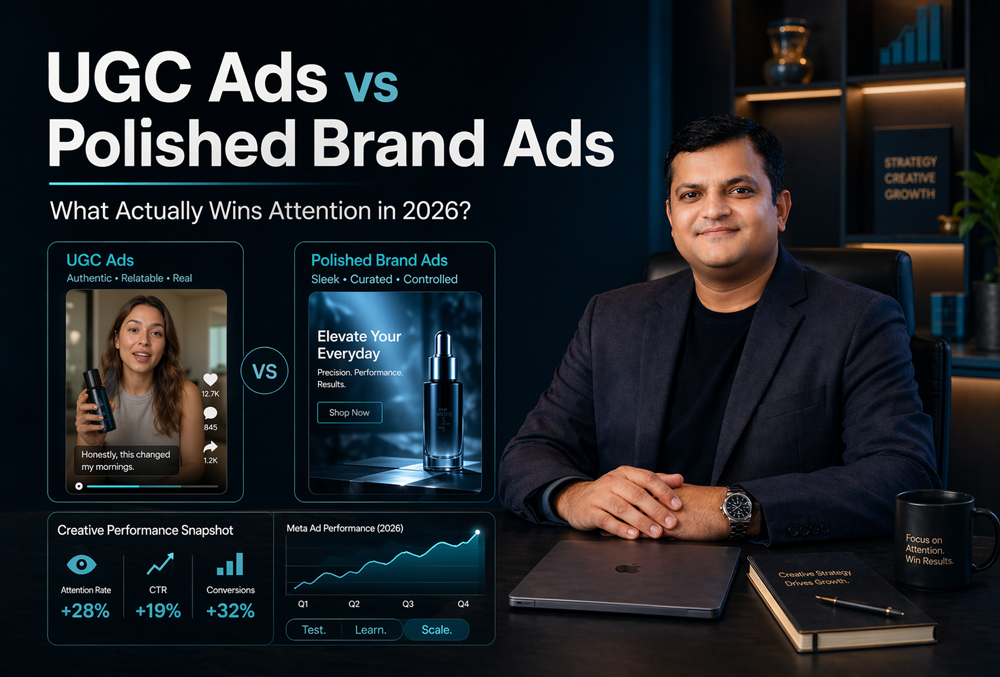
Expensive production har baar better result nahi deta. If you are a founder or growth leader, you already know the pain. You drop thousands of dollars on a beautifully shot, high-end studio ad. It looks premium in the boardroom. You launch the campaign, and it dies in the feed. Your CPA goes through the roof. Meanwhile, a competitor scales rapidly using a shaky iPhone video.
Here is the blunt answer first. In 2026, neither pure UGC-style ads nor highly polished brand ads win by default. The winners are the brands using the right style at the right stage of the funnel, with enough creative diversification to avoid ad fatigue.
If you care about a highly profitable Meta ads creative strategy, you must stop asking, “Which one looks better?” The real business problem is: Which creative style earns attention fast enough, builds trust quickly enough, and converts before fatigue kicks in? Nielsen’s long-running research makes it clear: strong creative can be the dominant driver of digital ad success, while weak creative leaves media to do the heavy lifting. In this breakdown, we will diagnose exactly how to deploy UGC ads, polished brand ads, and hybrid formats to lower your CPA and scale revenue predictability.
The Brutal Reality of Ad Fatigue in 2026
Meta is not quietly hinting at this shift. They are saying it out loud.
Creative fatigue happens when people see the same visual format too often, causing your CTR to slide and your CPA to climb-even if your targeting and offer are perfect. Meta explicitly recommends rotating distinct creatives to prevent engagement decline.
At the same time, Meta is actively rewarding platform-native execution. Recent business guidance reveals that campaigns using strong creative fundamentals across placements saw a 16% lower CPA, 29% higher conversion rate, and 11% greater reach.
The old “UGC vs polished” debate is too binary for how people actually buy today. If your creative system cannot hold attention, earn trust, and refresh at speed, you are burning cash.
Where UGC Ads Actually Win (and Why)
UGC-style ads usually win when the buyer is skeptical, scrolling fast, and looking for proof from a real person rather than a polished brand voice. This is why creator ads and peer-like content keep gaining ground.
According to Meta, adding partnership ads into business-as-usual campaigns can reduce CPA by 19%, with a 71% lift in intent and brand awareness.
The psychology here is not mysterious. UGC feels closer to experience than to persuasion. Recent Emerald research shows that UGC brings authenticity and credibility. It works best in categories where the buyer asks, “Will this actually work for someone like me?” Think D2C skincare, supplements, fashion, EdTech, and consumer SaaS.
If the ad reduces perceived risk, it earns the click. UGC-style creative is often the better cold-audience opener because it compresses social proof, relatability, and trust into a faster first impression.
Where Polished Brand Ads Still Outperform
Polished brand ads are not dead. That narrative is lazy. They still matter deeply when your product needs controlled framing, better explanation, stronger premium cues, or a tighter brand world.
Research published in the Journal of Business Research found that in short-form video ads, trustworthiness, expertise, and attractiveness are positively related to purchase intent. More “real” is not always better, and more “brand” is not always better.
Polished ads still win in these specific situations:
- Premium Price Points: Where cheap-looking creative actively reduces the perceived value of a luxury or high-ticket item.
- New Category Explanation: Where structural clarity and feature visualization matter more than spontaneity.
- Retargeting (MOFU/BOFU): Where the buyer already knows you but now wants product confidence and structured claims, not just relatability.
- Brand Launches: Where visual consistency and memory structure matter for long-term equity.
The 2026 Winner: Attention Goes to Clarity First
If I had to reduce this entire methodology to one operating rule, it would be this: Attention goes to clarity first, credibility second, and polish third.
A 2026 study in the Journal of the Academy of Marketing Science found that short and visually simple scenes create higher attentional synchrony, improving immersion and ad recognition. A lot of “premium” creative loses not because it is premium, but because it is visually busy, slow to reveal value, or too cinematic for a fast-feed environment.
The creative that wins attention in 2026 feels native to the platform, gets to the point early (often using vertical video and audio), and preserves brand coherence.
UGC vs Polished Ads: A Grounded Decision Table
| Scenario | UGC-Style Ad is Stronger When… | Polished Brand Ad is Stronger When… |
| Cold Prospecting | You need relatability, proof, and low-friction curiosity. | You need category framing and immediate premium perception. |
| D2C Product Demo | Real-person use builds trust faster. | The product needs clear feature visualization. |
| SaaS / EdTech | Customer voice reduces initial skepticism. | Product flow needs controlled, step-by-step explanation. |
| Retargeting | Objection handling needs testimonial-style proof. | Brand authority and structured claims matter more. |
| Scaling | You need more creator angles to fight fatigue. | You need message control across larger daily spends. |
How to Test Meta Ad Creatives Without Wasting Budget
Most brands test this badly. They compare a weak UGC ad against a strong polished ad, then pretend they learned something strategic. A rigorous Meta ad creative testing system looks like this:
- Keep the Offer Constant: Do not change the discount, CTA, or landing page while testing creative styles.
- Keep the Hook Theme Constant: Test the exact same marketing angle in two executions:
- UGC-style: Creator narrative, handheld framing, real-use proof.
- Polished: Controlled framing, cleaner product storytelling, tighter art direction.
3. Measure the Right Stack: Do not just look at vanity metrics. Track Thumb-stop ratio (3-second hold proxy), CTR improvement Meta ads, Landing page view rate, and CPA.
4. Refresh by Signal, Not by Calendar: Do not refresh creatives just because “it has been two weeks.” Refresh when the ad shows the classic fatigue pattern: CTR slides, CPA rises, and frequency grows without a proportional return.
Why Pixi Labs Is the Best Partner for Solving Ad Fatigue
Pixi Labs is not a generic design vendor. We are a performance-driven Meta creative partner that uses visual intelligence to increase CTR, lower CPA, and extend scale before fatigue destroys your economics.
What makes our partnership valuable is the operating model behind the designs. We frame our creative strategy around five strict layers:
- Hook Architecture: We design the first 1–3 seconds for aggressive interruption, not decoration.
- Trust Layer Design: We strategically map where creator proof, customer proof, and brand proof should appear.
- Format Fit: Reels ads, Feed, Stories, and static assets are never treated like the same canvas.
- Fatigue Mapping: We identify exactly which element is wearing out-the angle, visual style, pacing, or claim structure.
- Variant Systems: We build creative families, not one-off winners, ensuring your scale does not collapse after one successful ad.
Case Study: Rebuilding Scale for a D2C Beauty Brand
Context: A mid-size D2C beauty brand came to us with a familiar problem: polished videos looked expensive, but CTR was weak, and CPA kept rising rapidly after short bursts of spend.
Approach: We rebuilt their creative mix into a two-layer system. We deployed UGC-style creator hooks with simple scenes and vertical audio for cold prospecting. For remarketing, we used cleaner, brand-controlled product proof with review-led overlays.
Outcome: Better click quality, lower wasted spend, and a massive drop in CPA. The account stopped forcing one aesthetic to do every job, resulting in a highly profitable, fatigue-resistant system. That is the difference between simple creative production and elite creative strategy.
Conclusion
So, what actually wins attention in 2026? Not expensive production by itself. Not raw UGC by itself.
The winner is the brand with a sharper Meta ads creative strategy: one that understands audience temperature, matches the visual style to the buying moment, keeps scenes simple to hold attention, and refreshes before fatigue wrecks efficiency.
Stop guessing why your ads are dying. Download our free Meta Creative Testing Scorecard + Ad Fatigue Tracker today. This comprehensive matrix includes our hook scoring framework, a Reels attention checklist, and the exact fatigue signal tracker we use to scale 8-figure brands. Transform your creatives from an unpredictable expense into a reliable conversion engine.
FAQ
- Do UGC ads perform better than polished brand ads on Meta?
Sometimes, but not automatically. UGC-style ads perform better when you need fast trust, relatability, and social proof (usually cold traffic). Polished ads perform better when the offer needs premium framing, clear product explanation, or stronger brand control (often retargeting).
- Why do polished ads sometimes get low CTR on Meta?
A polished ad can fail if it is visually dense, slow, or too brand-centric for a feed environment. New research shows short, visually simple scenes hold attention better. The issue is often not that it is “too polished,” but rather poor platform fit.
- Are partnership ads worth using in a Meta ads creative strategy?
Yes. Meta states that adding partnership ads into business-as-usual campaigns can reduce CPA by 19%. Creator-led paid distribution should absolutely be part of a serious creative testing roadmap to build trust quickly.
- How do I know if ad fatigue is the real problem?
Meta defines creative fatigue as the point where the audience has seen the same creative too many times. Look for the exact signals: falling CTR, rising CPA, repeated high frequency, and lower efficiency from a previously winning ad.
- What is the best format for Meta ads in 2026?
There is no single best format, but Meta strongly favors platform-native vertical video (9:16) with audio and mixed creative sets. Diversifying your formats-combining Reels ads, statics, and motion-routinely produces lower CPAs.
- Should D2C brands use UGC for cold traffic and polished ads for retargeting?
Very often, yes. Cold traffic usually requires trust and relatability to break skepticism, while warmer traffic needs clearer proof, structured messaging, and better product framing to validate the purchase decision.
- Does higher production quality increase ROAS?
Only when it supports the job the ad needs to do. High production cost is not the same thing as strong creative. Production quality helps when it increases clarity and premium trust; it hurts when it slows down the message or looks like a television commercial in a social feed.
- What should I test first: hooks, creators, or visuals?
Start with the hook (the first 3 seconds) and the trust mechanism. If the opening doesn’t earn attention, the rest of the ad doesn’t matter. Once you find a winning hook, expand into variations (creator-led vs. brand-led) to fight fatigue.
About the Author