


The campaign starts well. CTR looks healthy. CPA is manageable. ROAS is moving. Then suddenly, everything slows down.
The first reaction from most founders and growth leaders is entirely predictable.
“The algorithm is acting up.”
“Zuckerberg changed the rules again.”
“Our audience got saturated.”
Sometimes, platform shifts do happen. But most of the time, the real issue is much simpler.
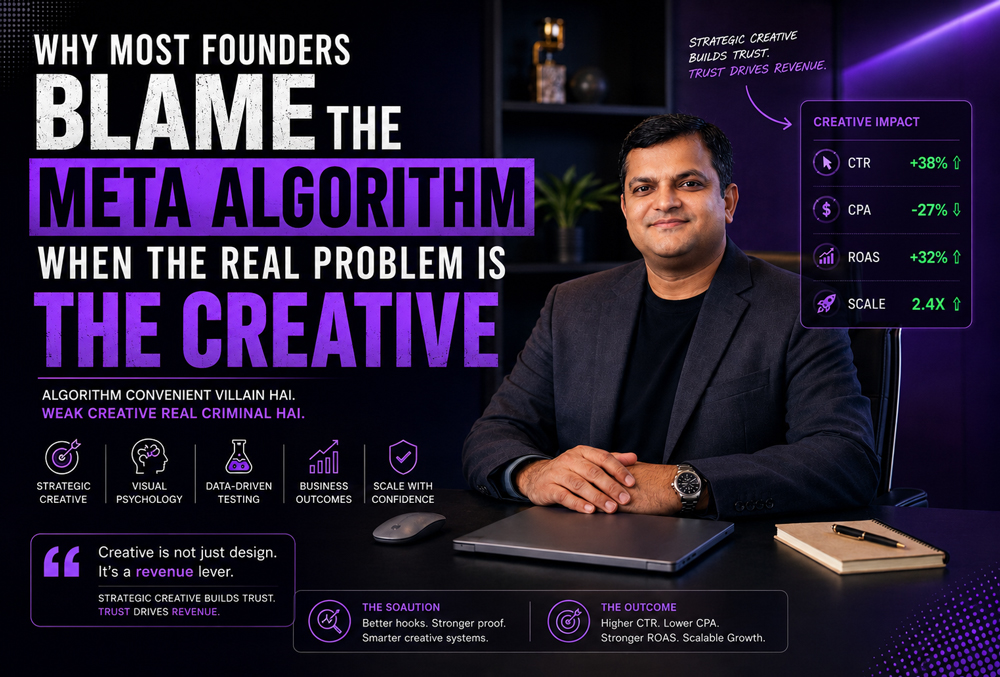
Here is the truth. Algorithm convenient villain hai. Weak creative real criminal hai.
Most founders do not have a Meta Ads problem. They have a Meta Ads creative strategy problem. Your audience has already seen the same promise, the same visual, the same product shot, and the same offer too many times.
When your ad account is tanking, the algorithm is often just exposing the truth faster: your creative is not strong enough to earn attention anymore.
The Direct Answer: Why Meta Ads Stop Performing
Meta Ads usually stop performing because the creative loses novelty, relevance, clarity, or trust. A campaign can have the perfect audience and budget, but it will fail if the ad creative does not make people stop, understand, believe, and act. In today’s automated landscape, creative acts as your targeting. Better creative directly improves CTR (attention), lowers CPA (conversion efficiency), and boosts ROAS (buyer quality).
The Dangerous Misdiagnosis Founders Make
When performance drops, most teams open Ads Manager and start touching everything except the creative. They change targeting, duplicate ad sets, tweak budgets, blame CPMs, and blame the media buyer.
But ask yourself one serious question: When was the last time your creative system actually changed?
Not the headline. Not the button color. Not a tiny layout shift. I mean the actual strategic creative angle.
Most brands do not have a creative strategy. They have creative decoration.
Nielsen research found that creative has historically been one of the biggest drivers of ad sales lift, with one Project Apollo finding showing that 65% of brand sales lift from advertising comes from creative. When you treat ad design like a basic “banner task,” you severely reduce the ceiling of your campaign.
A real creative change looks like this:
| Weak Change (Decoration) | Strategic Creative Change (Performance) |
| New background color | New customer pain angle |
| Different CTA button | Different buying trigger |
| Same product shot with new text | New visual story |
| Same offer in a new template | New trust-building mechanism |
| Same testimonial design | New proof format |
The Algorithm Is Not Magic. It Needs Strong Inputs.
Meta has become heavily automated. Targeting is broader, and placement delivery is smarter. Reuters even reported that Meta aims to allow brands to create and target advertisements entirely with AI tools by the end of 2026.
This creates a dangerous misunderstanding among C-suite leaders: Automation removes the need for strategic creative.
It does not.
- Automation can distribute creative, but it cannot fix a weak promise.
- Automation can test variants, but it cannot invent a sharp customer insight.
- Automation can optimize delivery, but it cannot create trust where the visual feels cheap.
The future of Meta Ads is not less creative strategy. It is more. Because when targeting is automated, creative is the new targeting.
Your ad angle tells Meta exactly who to go after. A discount-led creative attracts bargain hunters. A premium, proof-led creative attracts serious buyers. A problem-agitation ad attracts frustrated users. Same product. Different creative. Different buyer quality.
What Weak Creative Looks Like in a Real Meta Account
Weak creative is not always ugly. Sometimes it looks clean, polished, and highly branded. But it still fails because it does not trigger a buying response.
Here are the four common patterns I see destroying ROI in D2C, E-commerce, SaaS, and EdTech accounts:
1. The Ad Looks Like a Brochure
It shows the product, says the name, and adds a generic benefit. But it completely fails to answer the buyer’s immediate internal question: “Why should I care right now?”
2. The Hook Is Too Soft
Generic statements are not hooks.
Weak: “Upgrade your skincare routine.”
Weak: “Grow your business with better ads.”
A strong hook attacks a real buying tension.
Strong: “Your ₹5 lakh ad spend is being judged by a ₹500-looking creative.”
Strong: “Your CPA problem may not be targeting. It may be trust.”
3. The Design Has No Visual Hierarchy
Everything is shouting. Big headline. Big product. Big badge. Big CTA. When everything is important, nothing is important. High-performing Meta creatives meticulously control the eye: First attention point → Main promise → Proof/Context → Next action.
4. The Creative Does not Match the Buying Stage
A cold audience needs curiosity, pain, education, or contrast. A warm audience needs proof, comparison, and objection handling. When one single creative tries to do everything, it becomes weak everywhere.
The Creative Fatigue Framework: 5 Signals to Watch
Ad fatigue does not arrive suddenly. It leaves data trails. Use this diagnostic framework before blaming the algorithm. Meta itself notes that seeing the same image or video too many times leads to lower engagement and negative delivery impact.
| Signal | What It Usually Means | The Creative Fix |
| CTR Drops (< 1%) | Hook has lost stopping power. | Inject a new visual angle and aggressive headline. |
| CPC Rises | Audience is actively ignoring the ad. | Improve first-frame clarity and visual contrast. |
| CPA Rises steadily | Clicks are low intent, or trust is weak. | Introduce better proof (UGC, data) and offer framing. |
| Frequency Rises (> 3.0) | Same people seeing the same ad too often. | Creative rotation and entirely new concepts. |
| Comments Decline | Ad no longer creates a reaction. | Shift to more native, human, story-led creative styles. |
You do not scale with one winning ad forever. You scale with a creative pipeline.
Ad Fatigue Solutions: A Better Meta Ad Testing System
Most teams test creative randomly. One day it’s UGC, the next a carousel, then a meme. This generates data, but zero insight. At Pixi Labs, we use a structured testing system.
Step 1: Test Angles First, Formats Second
Before deciding if a carousel beats a video, test the buyer psychology. A weak angle in a beautiful format will still lose.
- Pain-led: “This problem is costing me money.”
- Proof-led: “People like me are getting results.”
- Comparison-led: “This is better than my current option.”
Step 2: Test Visual Hooks
The first frame decides the ad’s fate. Test a face vs. a product. A problem visual vs. an outcome visual. Raw UGC vs. polished design.
Step 3: Test Proof Formats
Do not limit proof to a standard screenshot. Test customer quotes, result metrics, before-after transformations, founder explanations, or comparison tables.
Step 4: Test Offer Framing
The exact same discount performs differently based on psychology. “20% off today” feels different than “Try the starter kit before buying full-size.”
Visual Psychology: Why Some Creatives Stop the Scroll
Good Meta ad design is not about looking expensive. It is about reducing decision friction. Nielsen’s creative research highlights attention, emotional response, and visual hot spots as critical areas for development.
Every successful ad masters The 4 Visual Decisions:
- Contrast: The main message must stand apart from the background.
- Hierarchy: The user’s eye must move in the exact order you dictate.
- Context: Show the product in a situation that instantly communicates value.
- Trust Cues: Reviews, numbers, founder presence, and visual consistency influence perceived credibility. A cheap-looking ad makes a premium product feel risky.
Why Pixi Labs Is the Best Partner for Solving Ad Fatigue
Pixi Labs is not a generic design agency. We do not create “nice-looking ads.” We build performance-driven Meta ad creatives and visual intelligence systems for founders and marketing leaders who want better CTR, lower CPA, and scalable growth.
Most agencies ask, “What design do you need?”
We ask, “Why did the current creative stop working? Which buyer stage is underperforming? Are we attracting buyers or only cheap clicks?”
Our work bridges Creative Strategy (buyer psychology), Direct-Response Design (visual friction reduction), and Performance Diagnosis (data-led iteration). We do not treat creative as an output. We treat it as the operating system of paid growth.
Case Study: How a D2C Brand Reduced CPA by 27%
Client Context: A mid-size D2C personal care brand was spending consistently on Meta Ads, but performance destabilized. CTR dropped, and CPA rose. The founder believed the audience was completely saturated.
Diagnosis: The audience was fine. The creative system was dead. They were recycling the same product image and discount message in different branded templates. It looked great but generated zero fresh attention.
The Pixi Labs Approach: We stopped decorating and started strategizing. We rebuilt the creative system around five specific angles: Problem-led hooks, ingredient education, UGC-style routines, before-after proof, and founder trust messages. We separated these creatives across cold and warm audiences.
Measurable Outcome (Within 30 days):
- CTR improved by 38%.
- CPA reduced by 27%.
- Retargeting conversion rate jumped by 21%.
- Client Insight: “We thought our Meta account needed a new structure. The real unlock was realizing our ads had stopped saying anything new.”
FAQ: Meta Ads Creative Strategy and Ad Fatigue
- What is Meta Ads creative fatigue?
Meta Ads creative fatigue happens when your target audience sees the same image, video, message, or offer too many times. Over time, people stop engaging. CTR drops, CPC rises, and CPA increases. The solution is introducing new creative angles, stronger hooks, and better proof.
- How do I know if my Meta Ads problem is creative or targeting?
Look at CTR, CPC, frequency, and CPA. If CTR is dropping while frequency is rising, creative fatigue is highly likely. If delivery is poor from the start, targeting or campaign setup may be involved. If clicks are high but conversions are weak, audit your landing page alignment.
- How often should I refresh Meta ad creatives?
There is no universal rule; it depends on spend. High-spend D2C brands may need new concepts weekly. The key is refreshing the creative angle—new hooks, new proof, new buyer objections—not just making small color tweaks to an existing template.
- What type of Meta ad creatives perform best?
The best creatives combine a sharp hook, clear visual hierarchy, strong proof, and a relevant offer. Depending on the funnel stage, UGC-style videos, founder-led ads, before-after visuals, comparison tables, and direct product demos all drive high performance.
- Can better creative reduce CPA?
Yes. Better creative reduces CPA by improving the quality of attention. When highly relevant people click and trust the offer faster, conversion efficiency skyrockets. It also helps Meta’s AI identify stronger engagement signals, lowering your CPMs.
- Should founders blame the Meta algorithm when ads stop working?
Not immediately. The algorithm dictates delivery based on user engagement. If an ad runs too long, engagement falls, and costs rise. Before touching the campaign structure, audit whether your ads still create attention, relevance, and trust.
- What is a creative testing framework for Meta Ads?
A strong framework tests buyer psychology first. Start by isolating angles (pain, proof, comparison, objection handling). Then test visual formats (static, video, UGC) against those winning angles. This generates repeatable learnings rather than random guesses.
- Why are premium ad creatives important for D2C and E-commerce brands?
For D2C brands, the ad is the first moment of trust. Before a buyer sees your website, they judge your product’s worth through the creative. Poor visuals make strong products look cheap, while strategic design increases perceived value, improves CTR, and makes scaling safer.
Conclusion: Stop Treating Creative Like Decoration
The Meta algorithm is not your easiest scapegoat anymore.
If your ads are bleeding money, look at the visual inputs you are feeding the machine. Is the hook still strong? Is the proof believable? Is the design building trust, or is it reducing your brand’s perceived value?
A strong Meta Ads creative strategy does more than just improve design. It improves business outcomes. It dictates your scale, your customer acquisition costs, and your ultimate profitability.
At Pixi Labs, we build Meta ad creatives like revenue assets. Stop guessing what works. Start designing to convert.
About the Author