


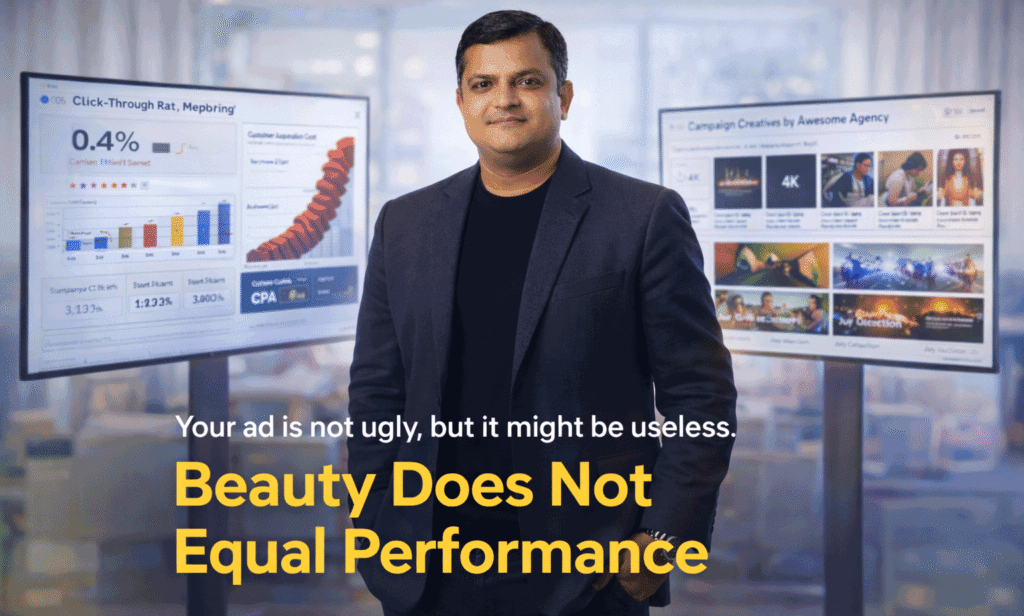
Your ad is not ugly,but it might be useless. Every week, I sit on consulting calls with D2C founders and Growth Heads who are completely baffled. They’ve just dropped $15,000 and waited four weeks for a boutique agency to deliver a batch of “stunning” 4K video assets. The cinematic lighting is flawless. The brand colors are strictly adhered to. The models are gorgeous.
They launch the campaign, expecting a massive Q3.
The result? A Click-Through Rate (CTR) of 0.4% and a Customer Acquisition Cost (CPA) that makes the CFO physically cringe.
Here is the hard truth that most design agencies won’t tell you: The Meta algorithm does not care about your brand guidelines. In the post-iOS14, Advantage+ era, the algorithm is your media buyer. And the only currency it accepts is user engagement and conversion.
If you are a marketing leader bleeding cash on highly polished creatives that refuse to convert, you need to hear this: Beauty does not equal performance. In my years of auditing millions in ad spend, I’ve found that the biggest bottleneck to scaling isn’t targeting—it’s creative. In this guide, I’m breaking down the exact Meta Ads creative strategy we use at Pixi Labs to diagnose ad fatigue, engineer ruthless visual hooks, and transform your creatives into your ultimate revenue engine.
1. The Aesthetics Trap: Why “Pretty” Sabotages ROI
When an ad looks too polished, the human brain instantly categorizes it as a “commercial.” And what do users do when they see a commercial on Instagram or Facebook? They swipe past it in 0.2 seconds.
Users have developed severe banner blindness. If your ad looks like it belongs on a billboard, it does not belong in a social feed. Traditional graphic design wants to win a Cannes Lion; direct-response design wants to win market share.
To lower your CPA and build a scalable system, you must shift your mindset from pure aesthetics to Visual Intelligence.
The Difference That Drives Revenue
| Metric | Brand-Centric “Pretty” Ad | Performance-Centric Ad |
| The First 3 Seconds | Slow cinematic fade-in, showing the logo | High-energy visual hook or bold, polarizing claim |
| Visual Style | Studio lighting, heavily produced | Native-looking, “lo-fi”, or authentic UGC style |
| Copywriting | Clever, vague, brand-focused | Direct, benefit-driven, problem-solving |
| Primary Goal | Awareness & “Vibes” | CTR, ROAS, and Conversions |
2. The 3 Pillars of a High-Converting Meta Creative
A winning Meta ad is never a happy accident. It is a meticulously engineered system. If your creative lacks these three pillars, you are simply donating money to Mark Zuckerberg.
Pillar 1: The Pattern Interrupt (The Hook)
Your visual hook dictates 80% of your ad’s success. Look at your Thumbstop Ratio (3-second views divided by impressions). If it’s below 25-30%, your ad is practically invisible.
- The Fix: You must break the visual monotony of the feed. We do this by addressing a painful problem immediately, using split screens, raw native text overlays, or startling visual demonstrations. No logos. No slow intros.
Pillar 2: The Retention Engine (The Body)
Once you buy their attention, you have exactly 5 seconds to justify the interruption. You must build dwell time.
- The Fix: Inject rapid-fire social proof, clear feature-to-benefit translations, and “Us vs. Them” comparisons. The pacing must be ruthless—cut the fluff, remove dead air, and keep the user’s brain rapidly processing value.
Pillar 3: The Frictionless Close (The Call to Action)
A confused mind never buys. Your ad must end with one singular, explicit command.
- The Fix: Do not say “Explore our world.” Say “Get 20% off your first order—Tap Shop Now.”
3. Curing Ad Fatigue: How to Revive Dying Campaigns
One of the most frustrating moments for a Growth Lead is finding a winning ad, scaling it beautifully for three weeks, and then watching the CPA double overnight.
Most brands panic, pause the campaign, and waste another month shooting entirely new concepts. This is incredibly inefficient. Elite ad fatigue management relies on modular iteration.
When a winning concept fatigues, it’s usually just the hook that has gone blind to the audience. The core message still works.
- The Hook Swap: Take your winning video, keep the body, and swap out the first 3 seconds. Launch 5 new hooks for the exact same core video.
- Format Shifting: Turn your best-performing static image into a fast-paced GIF or an animated “Stat-o-motion” ad.
- The Frankenstein Mashup: Splice the highest-converting 3-second hook of Ad A with the highest-retaining body of Ad B.
4. Scientific Creative A/B Testing Framework
Stop testing button colors. Testing whether a background should be blue or red is a waste of your Meta Pixel’s learning phase.
True creative A/B testing isolates psychological angles. When launching new creatives, test vastly different approaches to see what resonates with the algorithmic buyer:
- Angle A: The Founder Story (Authentic, trust-building, mission-driven).
- Angle B: The Agitation (Highlighting the pain point aggressively before introducing the product).
- Angle C: The Logical Teardown (A rapid review highlighting 3 specific, undeniable use cases).
Find the psychological lever that moves your audience, then iterate on the design execution. That is how you scale ad spend from $1k/day to $10k/day without breaking your CPA.
Why Pixi Labs Is the Ultimate Partner for Solving Ad Fatigue
At Pixi Labs, we do not just “make pretty ads.” We engineer conversion systems.
As a premier partner specializing in Performance-Driven Meta Ad Creatives & Visual Intelligence, we bridge the massive gap between graphic design and media buying. Most agencies hand you a Google Drive link and walk away. We look at your outbound click metrics, Thumbstop ratios, and conversion rates to design assets specifically built to scale your revenue.
We understand the visual psychology of the feed. We know how to position your brand as a premium industry leader while driving ruthless direct-response outcomes.
Case Study: Scaling a D2C Brand Through Visual Intelligence
- The Client Context: A premium mid-size D2C wellness brand came to us stuck at a $75 CPA. They were heavily reliant on beautifully shot, highly produced studio videos. The creatives looked like TV commercials, but their CTR was stagnant at 0.45%, and they couldn’t scale daily spend.
- The Approach: We ran a rigorous creative audit and executed a “Native-First” redesign. We stripped away the cinematic gloss, redesigned their assets using native Instagram UI overlays, introduced aggressive text-hook pain points (“Why your morning routine is causing brain fog”), and utilized “Us vs. Them” static grids.
- The Measurable Outcomes:
- 3.2x Increase in ROAS within 45 days.
- 48% Drop in CPA (from $75 down to $39).
- Scaled ad spend by 150% without triggering ad fatigue.
“Pixi Labs completely rewired how we view ad design. They didn’t just give us graphics; they gave us a scalable methodology that halved our acquisition costs. They speak the language of business impact, not just design.” — CEO, Mid-Market D2C Wellness Brand
FAQ: What Growth Leaders Ask About Meta Creative
- How often do I need to refresh my Meta ad creatives?
Refresh based on performance decay, not a calendar. If your CPA exceeds your target KPI for 3-5 consecutive days and your frequency climbs above 2.5 on prospecting, inject new creatives. Brands scaling aggressively usually test 3-5 new creative variations weekly.
- Are static images dead on Meta?
Absolutely not. Static ads are highly effective for direct-response, especially in retargeting. Bold “Us vs. Them” comparison charts, tweet-style graphics, and strong offer-based statics frequently outperform video for bottom-of-funnel conversions.
- What is a “good” Thumbstop Ratio?
An elite Thumbstop Ratio (3-second video plays / impressions) is 30% or higher. If yours is below 20%, your hook is failing, and the rest of your video—no matter how good—is going unseen.
- How do you solve ad fatigue without resetting the algorithm?
Never pause your winning ad cold. Duplicate the winning concept, change the visual hook, and launch it in a Dynamic Creative Testing (DCT) environment. Let the new variation gain traction before scaling down the fatigued original.
- Does UGC (User Generated Content) still work?
Yes, but the era of fake, over-acted UGC is dead. The new gold standard is “Polished UGC”—authentic, lo-fi footage that feels native to the platform but is aggressively edited by a performance strategist for pacing, captions, and direct-response CTAs.
The Bottom Line
Aesthetics will win you compliments; performance creative will win you market share. If your current growth strategy relies on hoping that “beautiful” branding will convince people to buy, you are fighting a losing battle against a ruthless algorithm. To dominate your category, you need a Meta Ads creative strategy rooted in data, rapid iteration, and psychological precision.
Ready to stop burning ad spend and start scaling?
Let’s diagnose your account.
Book a Free Executive Creative Strategy Call with Pixi Labs today, and we’ll map out exactly how to slash your CPA and build your next winning creative.
About the Author