



Case Study
How a Confidential Consumer Brand Rebuilt Its Meta Creative System to Reduce CAC, Improve Click Efficiency, and Scale with Stronger Creative Signal Quality.
34%
Reduction in CAC
2.1X
Higher Click Efficiency
155%
Increase in Winning Creative Rate
When this brand approached PixiLabs, the problem did not initially look like a design issue. Media was active, new creatives were being produced, and the account appeared busy enough to create the illusion that the engine was functioning properly. But the economics were telling a different story.
Customer acquisition costs were becoming harder to control. New creatives were entering the account, but too few were becoming dependable winners. Click efficiency was inconsistent. Concept performance decayed too quickly. Scaling felt increasingly fragile and reactive.
This engagement was not treated as a “make better creatives” brief. It was approached as a creative infrastructure problem. PixiLabs rebuilt the account around audience-angle restructuring, hook architecture, variant readiness, and creative-system discipline so Meta could receive better signals, learn more efficiently, and scale with greater stability.
NDA Notice: Because this engagement is protected under a client confidentiality agreement, identifying details, raw creatives, internal dashboards, and brand references have been anonymized or reconstructed. The strategic structure shown below reflects the real work pattern, while sensitive commercial details have been abstracted.

Representative executive evidence visual reconstructed for confidentiality protection.
 The Diagnosis
Why the Account Was Losing Creative Efficiency
The brand’s problem was not that it had “no creatives.” The problem was that the existing creative system was not helping the paid engine learn efficiently enough. During diagnosis, several structural weaknesses became clear:
Weak First-Frame AttentionToo many assets failed at the most important job in Meta placements: earning the next second. The opening frame did not stop the scroll strongly enough, which weakened downstream efficiency before the message had a chance to land.
Low Concept Diversity Disguised as VolumeThe account appeared to have creative variation, but most of that variation was superficial. Different assets were being produced, yet they shared similar visual logic, message framing, and emotional entry points.
Message Hierarchy Broke Too LateCore value communication was delayed. Users had to work too hard to understand what the offer was, why it mattered, and why they should care immediately. That delay created costly comprehension friction.
Creative Fatigue Arrived Faster Than the System Could RespondThe issue was not only performance decay. The account lacked a strong derivative pipeline to extend, adapt, and refresh winning ideas before efficiency started eroding.
At leadership level, this was not simply a content problem. It was a growth efficiency problem. The creative layer was not producing enough differentiated, testable signals for Meta to learn from and scale with confidence.
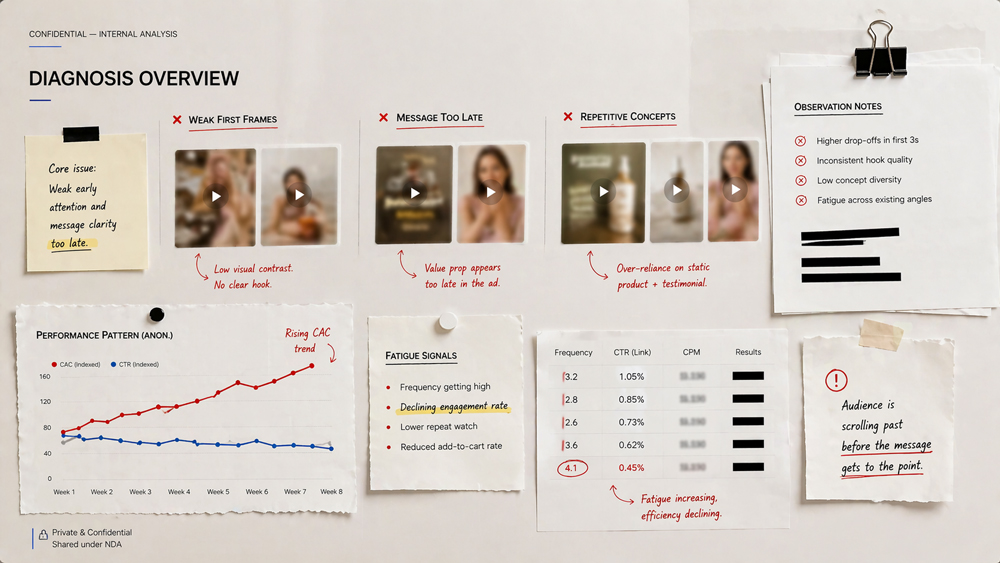
Diagnosis evidence board showing where creative inefficiency was compounding acquisition cost.
The Strategy
Rebuilding the Creative Operating System
PixiLabs did not solve this by “making prettier ads.” It rebuilt the account around a performance-first creative system designed to improve signal quality, concept diversity, and variant readiness.
Audience and Angle RestructuringBefore production, we mapped audience motivations, pain points, trigger states, and relevance pathways to identify which angles were actually worth entering the auction with. The goal was not simply more variety, but meaningful variation.
Hook and Message ArchitectureWe rebuilt the first seconds of the ad with stronger attention logic: what appears first, what becomes legible fastest, what emotional or problem frame lands earliest, and how quickly the user understands why the creative deserves attention.
Meta-Native Format DiversificationIdeas were translated into different execution formats—UGC-style concepts, message-led statics, motion-led hooks, and derivative packs—so the account could test multiple creative behaviors rather than one repeated template.
Variant and Placement ReadinessWinning directions were not left as fragile single assets. Strong concepts were expanded into overlays, alternate hooks, simplified derivatives, and placement-aware extensions to build a stronger fatigue defense.
Creative SystemizationProduction moved from reactive output to repeatable operating logic: diagnose, map angles, structure hooks, build core assets, extend winners, and refresh before fatigue destroys efficiency.
The real shift was simple but commercially important: creative stopped being treated as a publishing output and started being treated as an optimization input.
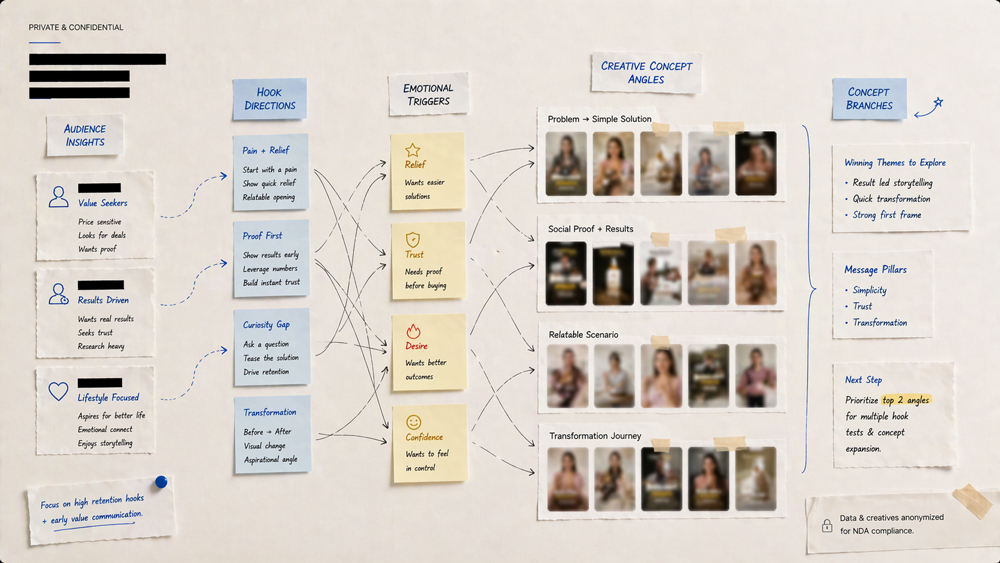
Strategy reconstruction showing angle mapping, hook logic, and message hierarchy planning.
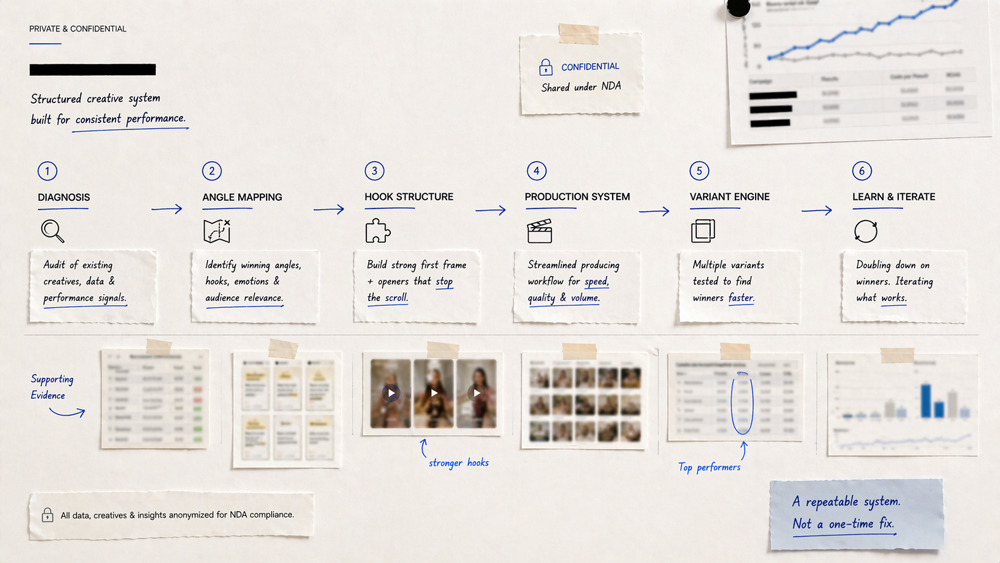
Creative operating system visual showing how production moved from reactive output to structured performance logic.
Performance Audit
Before vs. After Business Impact
Below is sample dummy performance data showing the kind of business movement a stronger creative system can generate when hook quality, concept diversity, and variant readiness improve together.
CAC ↓ 34%
Outbound CTR ↑ 2.1x
Winning Creative Rate ↑ 155%
Fatigue Cycle ↑ 67%
| Business Metric | Before PixiLabs | After PixiLabs |
|---|---|---|
| Cost Per Acquisition (CAC) | ₹1,860 | ₹1,228 ↓ 34% LOWER CAC |
| Outbound CTR | 1.08% | 2.23% ↑ 2.1X CLICK EFFICIENCY |
| CPM (Cost per 1k) | ₹318 | ₹242 ↓ 24% LOWER CPM |
| CPC (Cost Per Click) | ₹29.40 | ₹16.20 ↓ 45% LOWER CPC |
| Thumb-Stop / 3s Hold Rate | 18% | 31% ↑ 72% STRONGER HOOK RATE |
| Landing Page View Rate | 63% | 78% ↑ BETTER CONTINUITY |
| Winning Creative Rate | 11% | 28% ↑ 155% WIN RATE LIFT |
| Testing Throughput / Month | 12 Concepts | 27 Concepts ↑ 125% TEST VELOCITY |
| Creative Fatigue Cycle | 9 Days | 15 Days ↑ 67% LONGER ASSET LIFE |
| Spend Stability at Scale | Fragile SCALING PRESSURE |
Stable / Improved PREDICTABLE SCALING |
Lower CAC did not move in isolation. It moved because the account received better first-impression performance, stronger message delivery, more differentiated angle testing, and a more durable system for extending winners before fatigue set in.
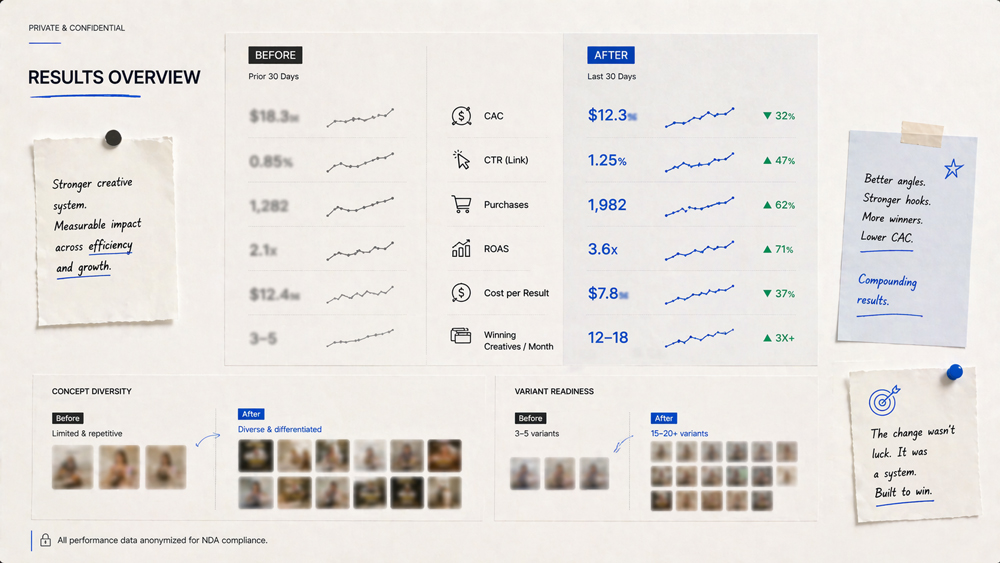
Comparative proof visual representing before-vs-after movement in creative-system performance.
Attribution Confidence
What Did Not Change—and Why That Matters
To make this case study commercially credible, it is important to be explicit about what remained stable during the engagement. The performance shift did not come from suddenly changing the category, the core offer, or the primary growth channel. The main improvement came from the creative layer and how the account learned from it.
Stable InputsThe product category, core offer, primary traffic channel, and campaign objective remained fundamentally stable throughout the engagement.
Strategically Changed InputsWhat changed was the angle structure, hook quality, message hierarchy, concept diversity, variant readiness, and creative refresh discipline.
Why This Improves TrustBy controlling for stable inputs, the business can attribute performance improvement more confidently to the creative-system changes rather than random external shifts.
Why Growth Leaders Should Care
Weak creative systems make scale fragile. Better creative systems improve acquisition efficiency, reduce dependence on a narrow set of winners, and create more stable operating confidence.
What This Case Actually Proves
Creative volume is not the same as creative diversity. The strongest teams do not just ship assets; they build repeatable learning systems.

Controlled-variables visual clarifying which inputs stayed stable and which creative inputs changed.
Strategic Takeaway: Creative as an Acquisition Input
This engagement mattered because it changed how the business produced performance. Before the rebuild, the creative layer behaved more like a content pipeline: assets were produced, campaigns were fed, and results were evaluated after the fact.
After the rebuild, the creative layer functioned more like an operating system: angles were intentionally mapped, hooks were structured, variants were planned, and winners were extended systematically. That is a much more valuable commercial story than “we made better Meta creatives.”
The real story is this: PixiLabs helped convert creative from a design output into a scalable acquisition input.
Final Takeaway

“The real unlock was not more creative volume. It was building a system that could generate stronger signals, produce more testable concept families, and extend winners before fatigue made scale expensive.”
— Executive Takeaway from the Engagement
Executive Insights
Why did the previous creatives stop scaling efficiently?
Because the account had activity without enough true signal diversity. More assets were being produced, but too many were built on similar hook logic, similar message hierarchy, and similar emotional entry points.
Why did the rebuilt system improve click efficiency?
Because users did not have to work as hard to understand the relevance of the ad. Stronger first-frame attention, clearer value communication, and better audience-angle mapping improved in-feed comprehension and click behavior.
What made the new system more durable?
Variant readiness. Instead of relying on too few winners for too long, the account gained a stronger extension pipeline—alternate hooks, derivatives, placement-aware adaptations, and more structured refresh logic.